APC3 plans to include the following excursions in Thailand before and after the conference. More information and update will be announced in the next circular.
Pre–conference FIELD EXCURSIONS
Route 1 : Sibumasu Palaeozoic fossils in Satun UNESCO Global Geopark and Krabi in southern Thailand
Dates: 24th – 28th February 2027
Highlight: Visit the Princess Maha Chakri Sirindhorn Natural History Museum at Prince of Songkla University. On the Satun mainland, within the Satun UNESCO Global Geopark, Early to Middle Palaeozoic shallow- and deeper-marine successions containing remarkable fossiliferous intervals will be examined, such as nautiloids, brachiopods, trilobites, and graptolites. Glacial-marine, peri-Gondwana Early Permian sediments through younger Permian tropical carbonates with spectacular fossils such as brachiopods, bryozoans, crinoids and burrows will be explored in Trang and Krabi. Special site of Jurassic sauropod bones with fossil wood/lignite jet is also included. Miocene lacustrine sediments with spectacular gastropod beds exposed along the shoreline will be examined, together with the present-day intertidal community and organisms washed ashore, including chitons, barnacles, sea cucumbers, and coral heads.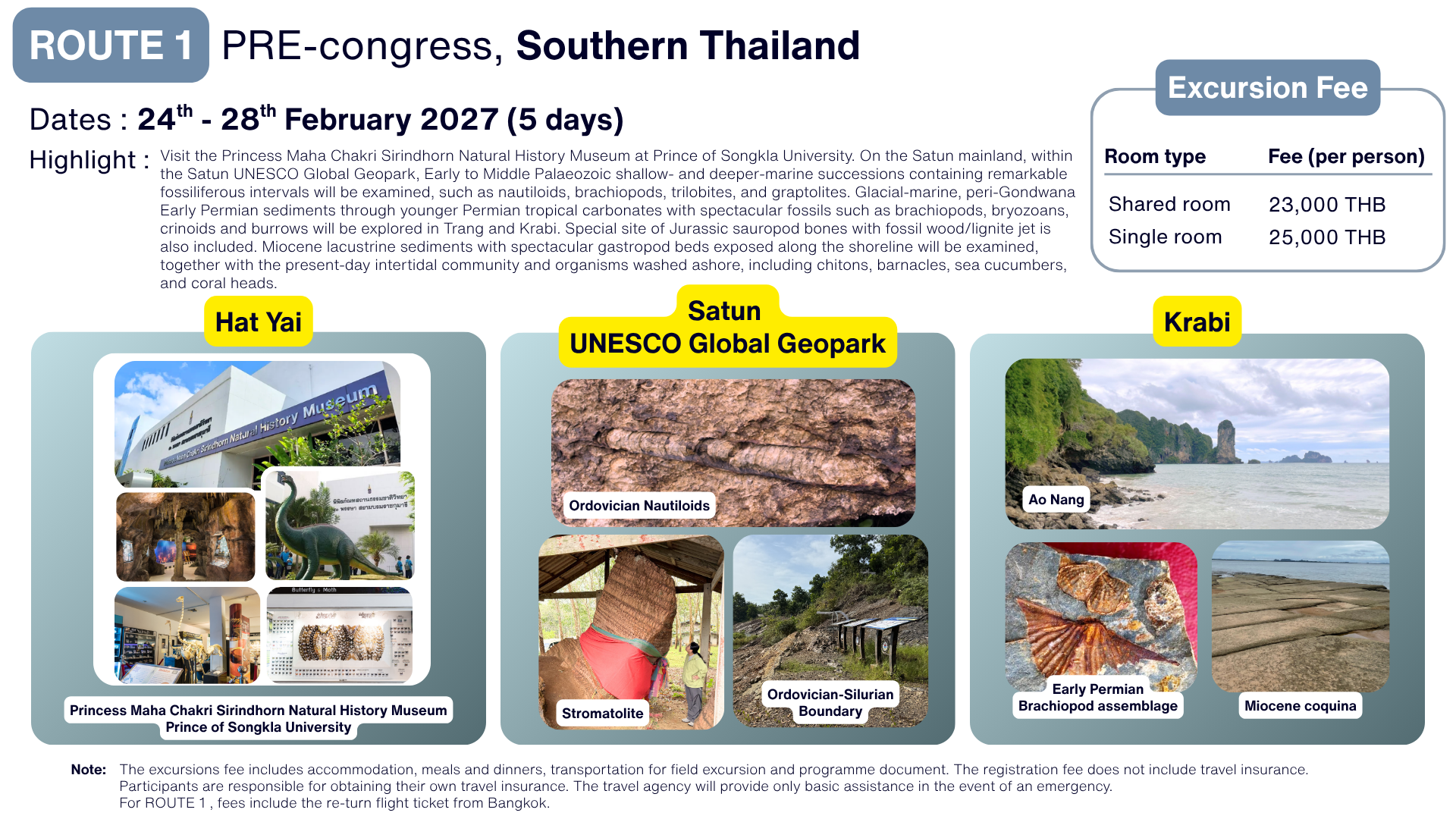
Mid–conference EXCURSIONS (one-day trip) : The wealth of Thai’s history & culture
Date: 4th March 2027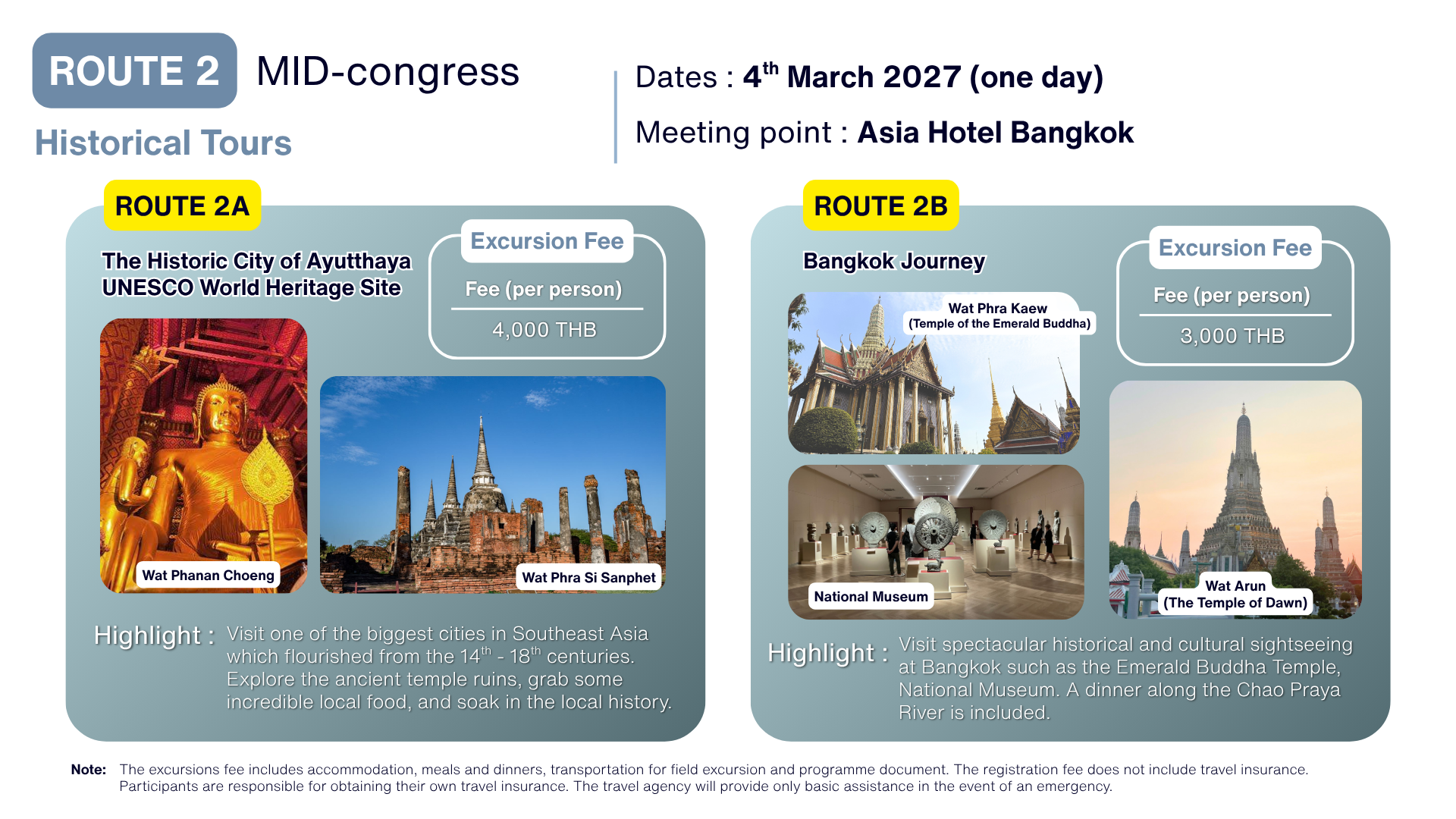
Post–conference FIELD EXCURSIONS
Route 3 : Permian marine strata along the margin of Khorat Plateau to the Mesozoic and Cenozoic non-marine fossil sites in geoparks
Dates: 6th – 9th March 2027
Highlight: Explore the non-marine fossiliferous strata of northeastern Thailand, including the Lower Cretaceous Khok Kruat Formation, where a new somphospondylan titanosauriform, Nagatitan chaiyaphumensis n. gen. n. sp., was discovered together with the freshwater shark Heteroptychodus, crocodile teeth, and bivalves. The excursion will visit the DMR’s Phu Wiang Dinosaur Museum and several excavation sites within Phu Wiang National Park, such as Excavation Site 1, where the type specimen of Phuwiangosaurus sirindhornae was discovered. The Jurassic Phu Noi excavation site in Kalasin Province will also be visited. This remarkable locality has yielded a newly discovered long-necked mamenchisaurid sauropod dinosaur, Uragasaurus kalasinensis n. gen. n. sp., along with diverse vertebrate fossils, including freshwater sharks, bony fishes, temnospondyl amphibians, turtles, crocodiles, and pterosaurs. The site is also the type locality of several vertebrate taxa, including the freshwater shark Acrodus kalasinensis, the bony fish Isanichthys lertboosi, the turtles Phunoichelys thirakhupti and Kalasinemys prasarttonggosothi, and the crocodile Indosinosuchus potamosiamensis. The excursion will continue to the Sirindhorn Museum (Phu Kum Khao Dinosaur Museum) and the Phu Kum Khao Site Museum in Kalasin, where more than 600 dinosaur bones, including articulated skeletons and isolated elements, are displayed in situ. Finally, participants will visit the fossil collections and exhibitions at the Palaeontological Research and Education Centre, Mahasarakham University.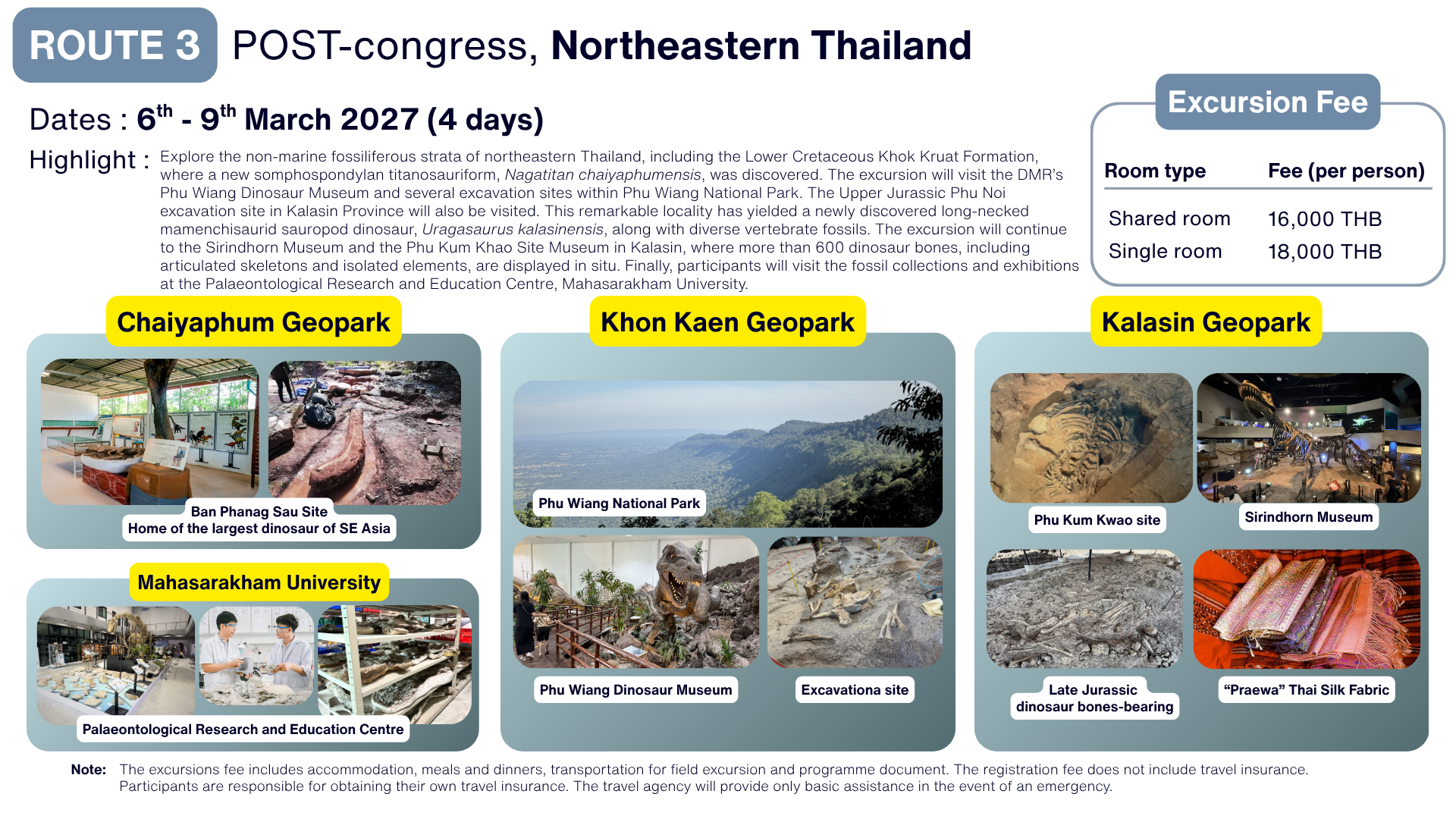
Route 4 : Permian marine sequence along the Khorat Plateau’s margin to the Mesozoic and Cenozoic non-marine fossil sites in geoparks
Dates: 6th – 9th March 2027
Highlight: Explore the dinosaur excavation site at Ban Pong Malaeng Wan, on the western margin of Khorat City. This site contains the largest known concentration of iguanodont fossils in Southeast Asia. Other discoveries include pterosaurs, freshwater sharks, turtles, crocodiles, mollusks, and other Cretaceous faunas. Six new species from these sites have been formally named and published: three iguanodonts, Siamodon nimgnami, Ratchasimasaurus suranareae, and Sirindhorna khoratensis; the carcharodontosaurian theropod dinosaur Siamraptor suwati; the turtle Kizylkumemys khoratensis; and the crocodile Khoratosuchus jintasakuli. The excursion will then proceed to the Khorat Fossil Museum, located only a few tens of minutes from the excavation site, to explore its fossil collections and exhibitions. Operated by the Northeastern Research Institute of Petrified Wood and Mineral Resources, the museum features three main exhibitions dedicated to petrified wood, ancient elephants, and dinosaurs. The Tha Chang fossil site will also be visited. This important locality has yielded diverse Neogene–Quaternary mammalian fossils, mollusks, and abundant fossil wood. The vertebrate assemblage includes ancient elephants (primitive proboscideans), rhinoceroses, hippopotamuses, pigs, anthracotheres, horses, deer, barking deer, apes, giraffes, saber-toothed cats, tortoises, soft-shelled turtles, crocodiles, and fish.
In the Chaiyaphum Geopark, participants will visit the Pha Nang Sua dinosaur excavation site, where a new somphospondylan titanosauriform, Nagatitan chaiyaphumensis n. gen. n. sp., was discovered together with the freshwater shark Heteroptychodus, crocodile teeth, and bivalves. The excursion will then explore the Permian shallow-marine fossils and sedimentary strata underlying the Khorat Group at selected geosites and local museum in the Phetchabun Geopark and the Lopburi area. Abundant Permain marine fossils such as brachiopods, sponges, massive rugose corals and fusulinids from the geosites and local museum in Ban Phot will be explored. A Middle Permian fossiliferous limestone locality east of Lopburi, containing spectacular and well-preserved giant alatoconchid bivalves, massive corals, gastropods, and fusulines, will be visited.
The excursion will also include important historical and cultural sites, including the Phimai National Museum and the Ancient Town of Si Thep. The former is located several tens of kilometres north of Khorat and provides insights into the region’s archaeological heritage and its connections with the Khmer civilization. The Ancient Town of Si Thep, Thailand’s seventh UNESCO World Heritage Site. Together with its associated monuments, the site represents the architecture, artistic traditions, and religious diversity of the Dvaravati cultural tradition from the sixth to the tenth centuries. It represents an important phase in the history of Southeast Asia and demonstrates the significant influence of Indian culture on the region.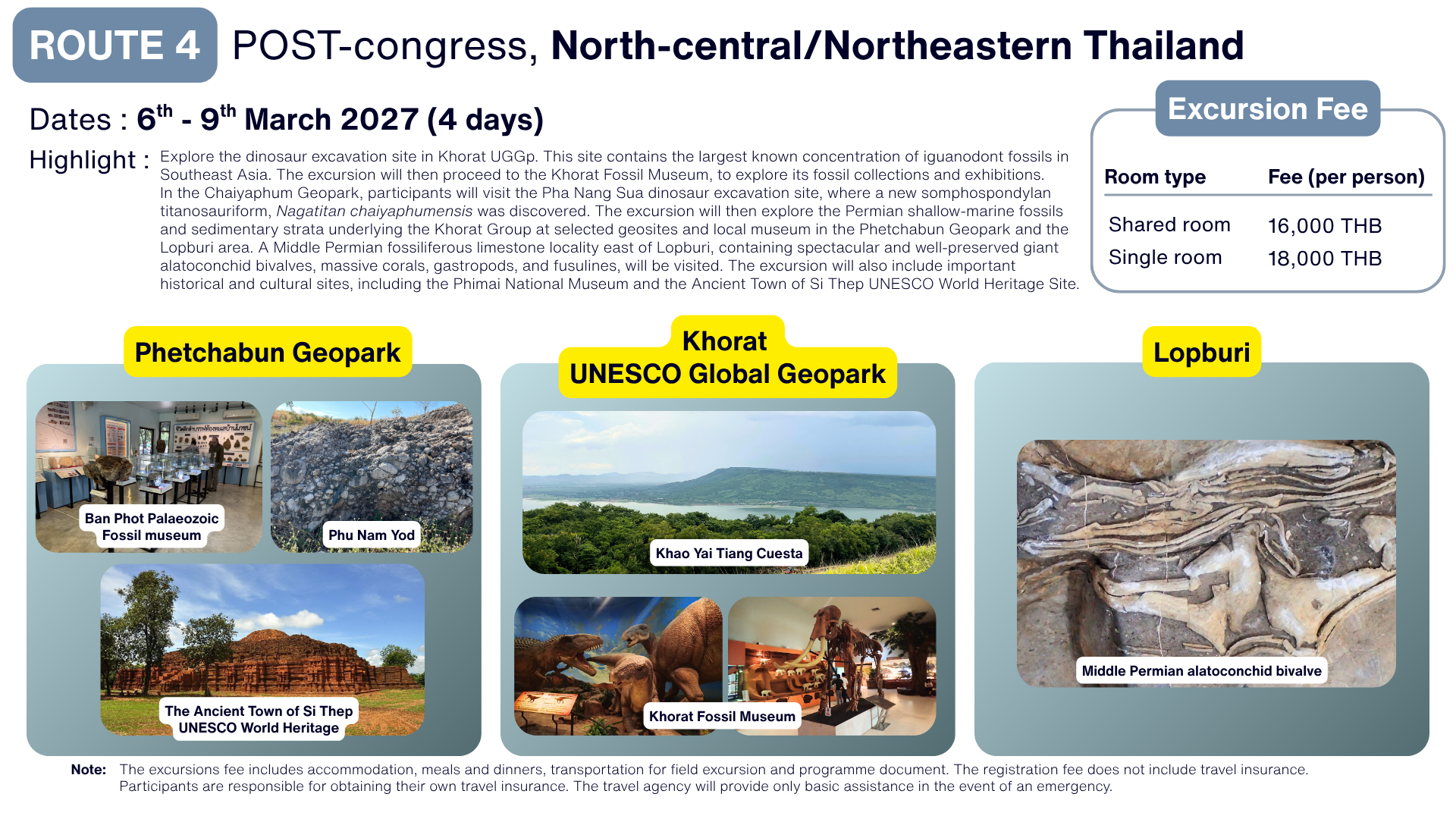
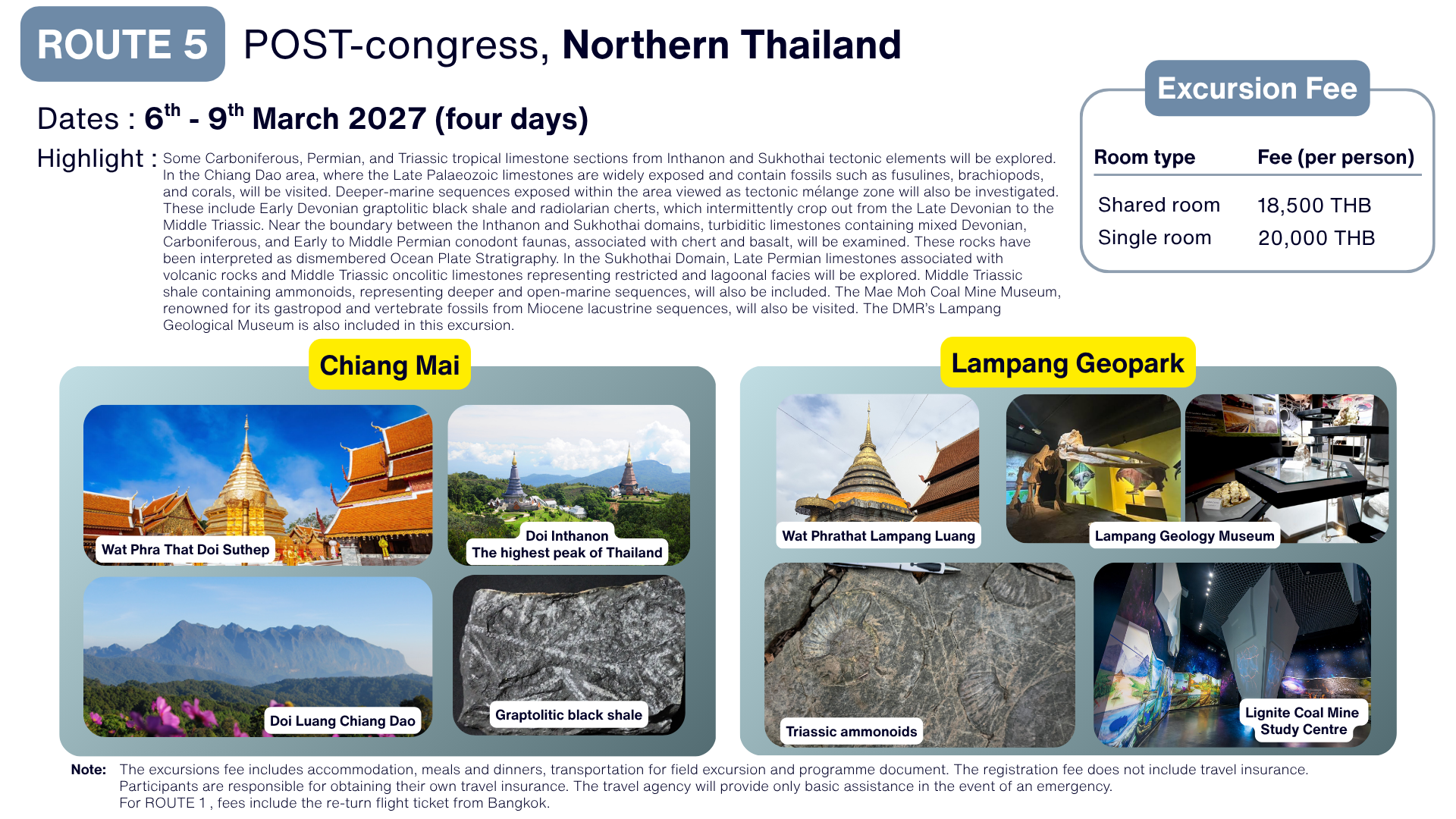
Route 5 : Late Palaeozoic and Triassic shallow and deep marine strata and fossils in the Inthanon and Sukhothai terranes
Dates: 6th – 9th March 2027
Highlight: Some Carboniferous, Permian, and Triassic tropical limestone sections from the Inthanon and Sukhothai tectonic elements will be explored. In the Chiang Dao area, north of Chiang Mai, which belongs to the Inthanon Terrane, where Carboniferous and Permian limestones are widely exposed and contain fossils such as fusulines, brachiopods, and corals will be visited. Deeper-marine sequences exposed within the area viewed as tectonic mélange zone will also be investigated. These include Early Devonian graptolitic black shale and radiolarian cherts, which intermittently crop out from the Late Devonian to the Middle Triassic and belong to the famous Fang Chert. Near the boundary between the Inthanon and Sukhothai domains, turbiditic limestones containing mixed Devonian, Carboniferous, and Early to Middle Permian conodont faunas, associated with chert and basalt, will be examined. These rocks have been interpreted as dismembered Ocean Plate Stratigraphy. In the Sukhothai Domain, Late Permian limestones associated with volcanic rocks and Middle Triassic oncolitic limestones representing restricted and lagoonal facies will be explored. Middle Triassic shale containing ammonoids, representing deeper and open-marine sequences, will also be included. The Mae Moh Coal Mine Museum, renowned for its gastropod and vertebrate fossils, including crocodiles, fishes, and turtles from Miocene lacustrine sequences, will also be visited. The DMR’s Lampang Geological Museum is also included in this excursion.